
Showing posts with label draw. Show all posts
Showing posts with label draw. Show all posts
Thursday, February 27, 2014


Tuesday, June 12, 2012
DIY Temporary Tattoos

via:
http://charlotteisnotmyname.tumblr.com/post/11523186764/temporary-tattoos-tutorialTemporary Tattoos Tutorial
Hey everybody!If you ever thought about doing a tattoo, but you don’t really want it to be something permanent, this is the perfect tutorial for you!
I’m going to show you how to do temporary tattoos. They’re fun, quick and easy to do!
So first of, what do you need?
Pencil (3B/4B/5B/6B), scissor, tracing paper; wet cloth, talcum powder, eyeliner, makeup brush, ethyl alcohol, cotton pads and liquid bandage spray (waterproof).
First you’ll need a drawing or word/phrase. Draw it on the tracing paper (making sure it’s the size you want) and cut it.
Scrub your skin with ethyl alcohol where you’ll be doing your tattoo and put the tracing paper over it (with the drawing facing down).
With the wet cloth, pressure the drawing against the skin. Remove the tracing paper and you should have an outline of the drawing on your skin.
Draw the tattoo with eyeliner. Wait a few seconds, then put a bit a talcum powder over the drawing and spread it around with the brush.
Again, wait a few seconds and then spray the drawing with the liquid bandage spray. Make sure it covers the entire area of the tattoo and let it dry. It will be is waterproof.
Done! Try not to rub it and it should last 3/4 days.
Have fun!
Monday, June 4, 2012
Creature Feature

Tuesday, May 1, 2012
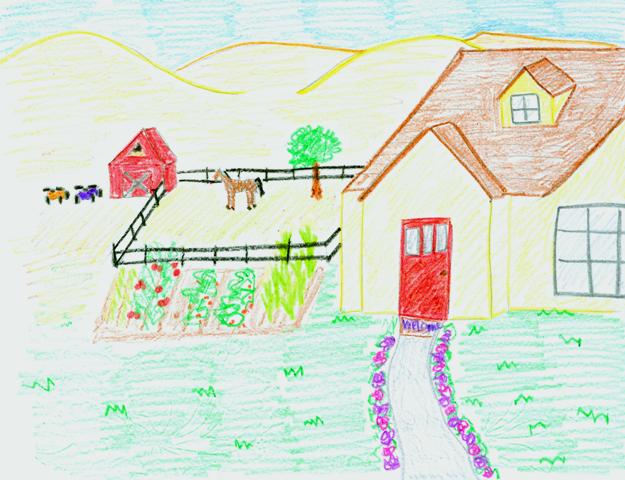
Designing a Dream House: Drawing & Thinking about a "Safe Place"

Issues: Powerlessness, insecurity.
Purpose: To help children design their dream house.
Materials: Crayons or markers, large construction paper, rulers,
pencils, and a sample house plan.
Procedure: Discuss the importance of dreams and the ability
to think about our dreams whenever we want to. Give each child paper, markers,
and other materials necessary to design their dream house. Encourage the
children to draw plans of a dream house that they can visit whenever they need
to. Younger children can describe the floor plan to you. You can draw the floor
plan. They can fill in the details.
Suggestions: Talk about safe places and how everyone needs
such a place. Ask them how a safe place would feel to them. Then have them look
at their dream house. Is there a safe place for them there? How could they
change their plan to include such a place?
Source: Making it Better: Activities for Children living in
a Stressful World, Barbara Oehlberg, Redleaf Press, 1996
Dream Family: Storytelling and Drawing
Issues: Lack of Empowerment or sense of control.
Purpose: To help children affirm their right to make choices
and have dreams.
Materials: Crayons or paint and paper.
Procedure: Explain
what a foster or adoptive family is. Then tell a story of a child, Henry, from
a land far away who traveled to a new city because his parents had died in an
accident. Henry had been told he would live with the Cassidy family on Oak
Street. But when he got to the house on Oak Street, no one named Cassidy lived
there. So, the grown-ups in the city offered Henry the chance to choose the
family of his dreams. Although Henry never forgot his first family, he found
ways to be happy with his new family.
After the story, ask the children to consider what they
would have selected if they had been Henry. Have them draw a picture of that
dream family. Assure the children the meaning of their picture will remain
personal and private to them.
Source: Making it Better: Activities for Children living in
a Stressful World, Barbara Oehlberg, Redleaf Press, 1996
Color Out All of the Anger and Sadness

Purpose: To teach children they have the ability to change their feelings and to comfort themselves.
Materials: Crayons and unlined paper.
Procedure: Suggest that children, when they need to, take a red-orange crayon and color out all the anger within them. Ask if they can feel the anger moving through their arms and hands as it leaves their body and becomes color on the page.
Suggest that children, when they need to, take a blue crayon and do the same to color out all the sadness or loneliness within them.
Ask the children what they can do, if they want to, to change their feelings. Ask what color they would color themselves when they choose to get angry when another person is angry. Then ask them what color they would color themselves not to get angry when another person is angry.
Source: Making it Better: Activities for Children living in a Stressful World, Barbara Oehlberg, Redleaf Press, 1996
Friday, January 13, 2012

Subscribe to:
Posts (Atom)